Happy 110th birthday to my all-time favourite actress: the incredibly talented, inimitable, hilarious, gorgeous Myrna Loy!
2 August 1905:

Myrna Loy Publicity Shot for Metro-Goldwyn-Mayer
Happy 110th birthday to my all-time favourite actress: the incredibly talented, inimitable, hilarious, gorgeous Myrna Loy!
2 August 1905:
Myrna Loy Publicity Shot for Metro-Goldwyn-Mayer
Venetia
**

Blanche’s Feminist Speech

I have no intention…
**
♣Venetia is our Feminism correspondent. She loves equality, swearing, and huge cups of coffee.
**
Blanche Fury certainly knew how to dress. She was always on point, whatever the circumstance: from poor relation to lady of the manor, sexy adulteress to “grieving” widow, she had it going on. Her lover, Philip Thorn, was right there with her, looking fine. Fine. Here are some of the occasions when Blanche and/or Philip looked better than we ever could:
♦Charlotte is our Fashion correspondent. Her dream closet consists of the collective wardrobes of 796 films.
On 27th March, 1899, a baby girl was born in the great Midwestern metropolis of Chicago. She grew up to conquer the world, armed with an arsenal of talent, wit, style, unusual beauty, and a staggering amount of well-justified ambition and self-confidence.
The camera loved her. Clothes loved her.
Fans loved her.
We still do.
**
Five (of the Many) Faces of Gloria
Magnificent:

Gloria Swanson in Male and Female, 1919.
Demure:

Gloria Swanson, Motion Picture Classic (1920).
Determined:
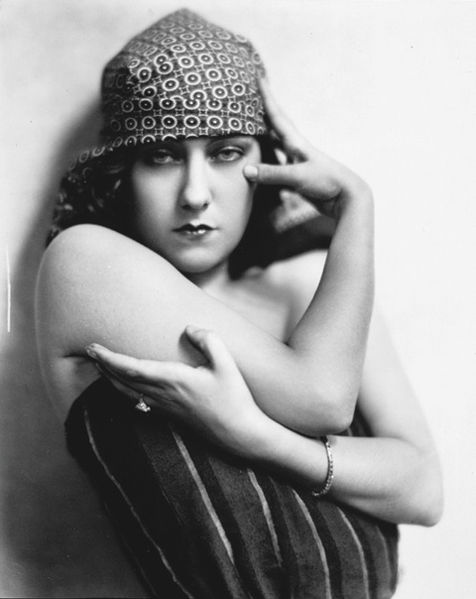
Gloria Swanson by Nickolas Muray, 1922.
Edgy:

Gloria Swanson in The Impossible Mrs. Bellew, 1922.
Timeless:

Gloria Swanson, Stars of the Photoplay (1924).
**
Happy birthday to the one, the only, the superb Gloria Swanson!
Until next time…
**
◊Effie is our Film correspondent. She (shockingly!) prefers House Peters’ profile to John Barrymore’s!
Another lovely upcoming blogathon in which we are participating!

Tom Ewell and Marilyn Monroe in The Seven Year Itch (1955)
We’re busy working on some new reviews…

Film #1
Film #2
Lizabeth Scott, Famed Film Noir Actress of the ’40s and ’50s, Dies at 92 [The Hollywood Reporter]

Lizabeth Scott in Yank Magazine, 1945
Not Your Average Rom Com Heroine
Venetia
**
Gilda Farrell is the unicorn of women movie characters: she’s unconventional without being (the cliched Hollywood-version of) a free spirit. Sure, most of us have heard that such a thing exists, without ever believing it could be true.
Trust me, dears. Gilda is the real deal.
She’s whip-smart, witty, straightforward, and determined to make the choices that are best for her. Even, as it turns out, when they are considered brazen or unbecoming of a “nice” woman. She starts with the awareness that women suffer from an almost unrelenting series of double standards:

Gilda’s Speech in Design for Living (1933)
From there, she decides to take action. This is why Gilda is so exceptional, why her decision to live romantically with two men is so fucking revolutionary. It is, also, why she is not a free-spirit:
To label her as such denies Gilda her self-governance, her experience, her bravery, and her brains.
Without them, she’d be just another silver screen beauty feigning eccentricity before accepting her fate as the good wife of an exceptionally handsome man.
Thank God for Gilda.
Her supposed immorality not only goes unpunished, but she gets to keep her self-respect, Gary Cooper, and Fredric March.
That’s pretty damn nifty.
**
♣Venetia is our Feminism correspondent. She loves equality, swearing, and huge cups of coffee.

The Miriam Hopkins Blogathon
There’s Just Something About Miriam
Effie
**
Miriam Hopkins was born to play Gilda Farrell. Not Noël Coward’s Gilda, of course. He created that role for Lynn Fontanne. Miriam’s Gilda was written by the hilarious Ben Hecht, and lovingly crafted for the silver screen by the great German director with the famous touch, Ernst Lubitsch. Together, they set Miriam up with one of the plum parts of her career: a progressive heroine for the ages. Her Gilda is just that: her Gilda. No one else could have filled her with such élan or intelligence, warmth or charm. For, you see, Miriam Hopkins was as exceptional a performer as Gilda is a character. To have one without the other is unthinkable!
**
There’s Just Something About Miriam…

Miriam Being Miriam
In an industry where conformity to one’s ascribed type is the ideal, if not quite a requirement, Miriam Hopkins’ transgressions against the celluloid status quo were enough to fill a small ledger.
On screen, she is demurely beautiful or joyously erotic or a sad excuse of a slattern. Her smile lights up the whole universe, but is often tamped down under a weight of sadness, fear, or anger. Miriam-the-actress knew how to toss a biting, pointed quip better than anyone. Than anyone. She was sexy as hell. Spiteful, generous, flirtatious. Girl embodied it all, and with such intelligence. Her special brand of It translates seamlessly from one genre to the next. She subtly Miriam-ified everything she touched.
Whether backed by good or bad material, her romantic comedy heroines were (and remain) truly different.
Especially Gilda.
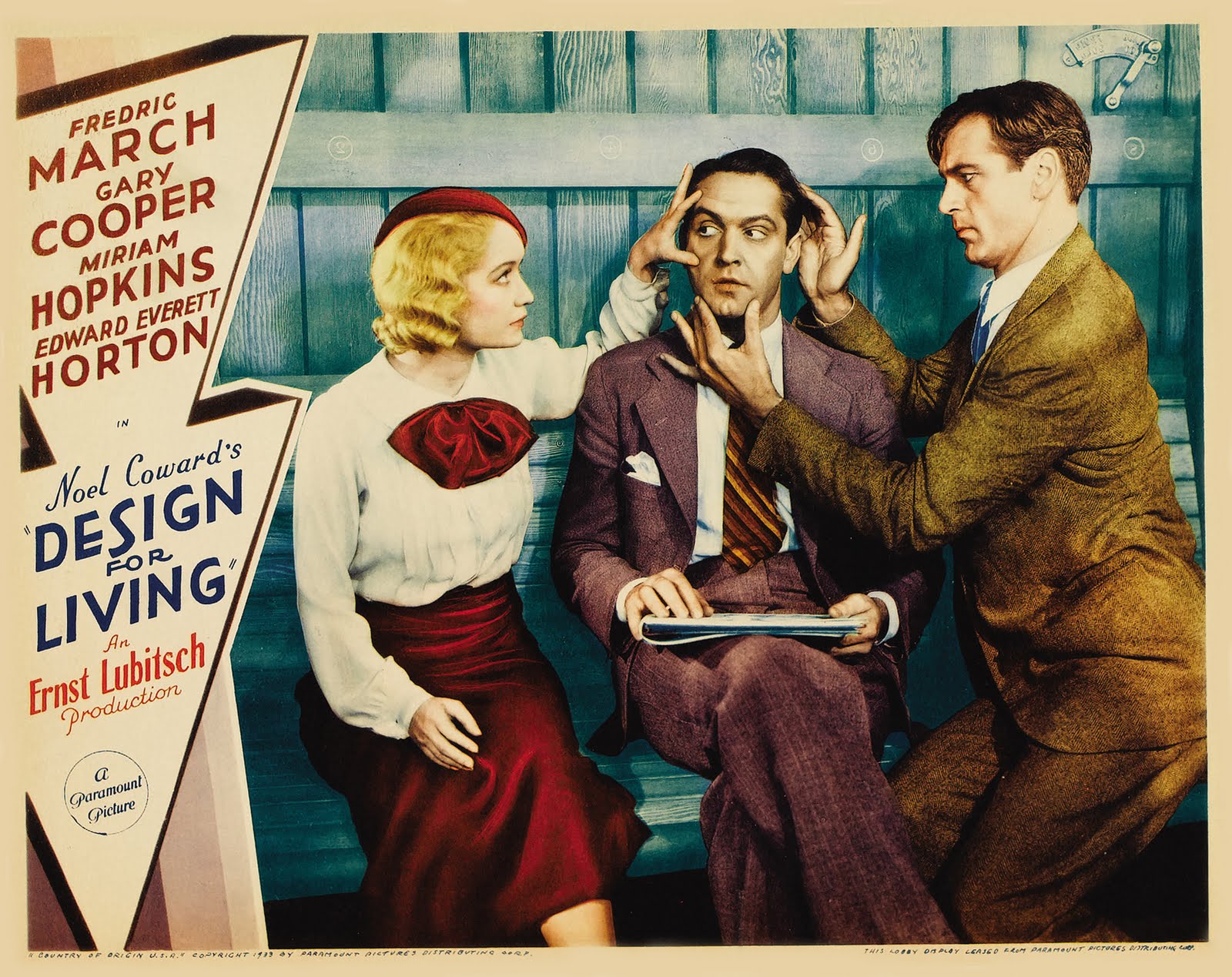
Design for Living Poster
Successful commercial artist Gilda Farrell is the emancipated heart of Design for Living (1933). After meeting flatmates and best friends, playwright Thomas Chambers (Fredric March) and painter George Curtis (Gary Cooper), on a train to Paris, she falls very much in like with both men.
The opening sequence is fresh, playful, and wickedly funny. The script gets off to a banging start, and never slows down for even half a heartbeat.
Case in point is her assessment of George’s painting of Lady Godiva (riding a bicycle): “I saw it with a friend of mine. She loved it. We haven’t spoken since.”
and
“You’re wisecracking with paint. It simply creaks with originality.”
Gilda is perceptive, and is not afraid to voice her opinions. Although acerbic, she is good-humored and down-to-earth. She also knows what she wants, and what she wants is Tom. And George.
Thus, after an insightful and mature conversation, their “gentleman’s agreement” is born.

Decisions, Decisions!
“Boys, it’s the only thing we can do. Let’s forget sex!”
They spend the rest of the film sticking to, and breaking, their pact. Gilda’s not so good at it, herself.
“It’s true we have a gentleman’s agreement, but unfortunately, I am no gentleman!”
Edward Everett Horton rounds out the main cast as Gilda’s boss, prospective paramour, and eventual (short-term) husband. You know that things have taken a drastic turn for the absurd when she leaves Tom and George to marry the fusty Max. If there’s one thing we have learned from E.E.H.’s many character parts, it’s that he is good for some laughs (albeit at his expense) but not romance or a roll in the hay. This is no exception. In the end, Gilda Farrell gets her man men. Both of ’em.
How’s that for a happy ending?
**
The Cast
After the horrors of the terrific Dr. Jekyll and Mr. Hyde (1931), it’s nice to see Miriam Hopkins and Fredric March engaging in a healthy, playful on-screen relationship. Gilda and Tom are as far removed from Ivy Pearson and Mr. Hyde as possible. Add in the magical Gary Cooper, who excelled in odd comedies, and you have as scrumptious a love triangle as ever existed. The three stars play off of each other in a natural, infectious way. Edward Everett Horton, too, is delightfully, if predictably, on point. The overall cast is so small (only eight actors are listed in the opening credits), that the issue of chemistry is vitally important. Fortunately, we need not worry. Their chemistry is even more impressive than Tom’s hit play, Good Night Bassington.
Credits
Fredric March, Gary Cooper, Miriam Hopkins, Edward Everett Horton, Franklin Pangborn, Isabel Jewell, Jane Darwell, Wyndham Standing
Directed by Ernst Lubitsch; Screenplay by Ben Hecht; Based on the Play by Noël Coward
91 minutes
Tasty Quotes
**
◊Effie is our Film correspondent. She shockingly prefers House Peters’ profile to John Barrymore’s.
Up next: In Part Two of our review, Charlotte gives us tips for dressing like Gilda.
The Miriam Hopkins Blogathon
 Font and Frock